
A New Way to Explore Mouse Models of Alzheimer’s disease
A new web-based tool is helping researchers navigate the growing landscape of next-generation mouse models for Alzheimer’s disease. Called the Model AD Explorer, the platform provides an interactive, centralized space to discover, compare, and analyze models with an emphasis on translational relevance.
Designed for neuroscientists, translational researchers, and drug discovery teams, the Explorer helps anyone in the AD research community select an appropriate mouse model for their research. It synthesizes data that have often been difficult to access or interpret across studies.
“One of the biggest barriers in the field has been accessing and evaluating raw data,” said Dr. Jessica Britton, a Principal Technical Program Manager at Sage Bionetworks involved in launching the project. “This tool makes high-quality datasets accessible to a much broader range of researchers, not just computational specialists.”
Dr. Britton and her colleagues have spent more than a year developing the Model AD Explorer. Their work included building new data pipelines, refining the user interface, strengthening the underlying application framework, and harmonizing and validating source data to ensure consistency and reliability.
The data come from the Model Organism Development and Evaluation for Late-onset Alzheimer’s Disease (MODEL-AD) Consortium. The consortium includes two centers: one led by the University of California Irvine, and another jointly run by the University of Indiana, The Jackson Laboratory, and the University of Pittsburgh.
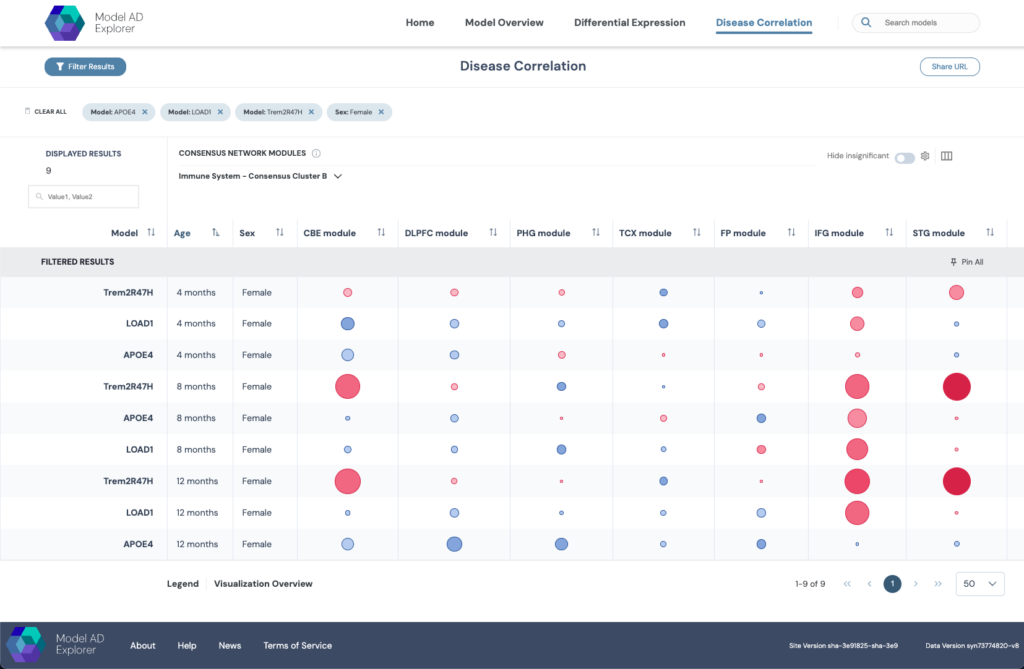
The Model AD Explorer is an interactive, web-based platform designed to help researchers discover, compare, and analyze next-generation mouse models of Alzheimer’s disease.
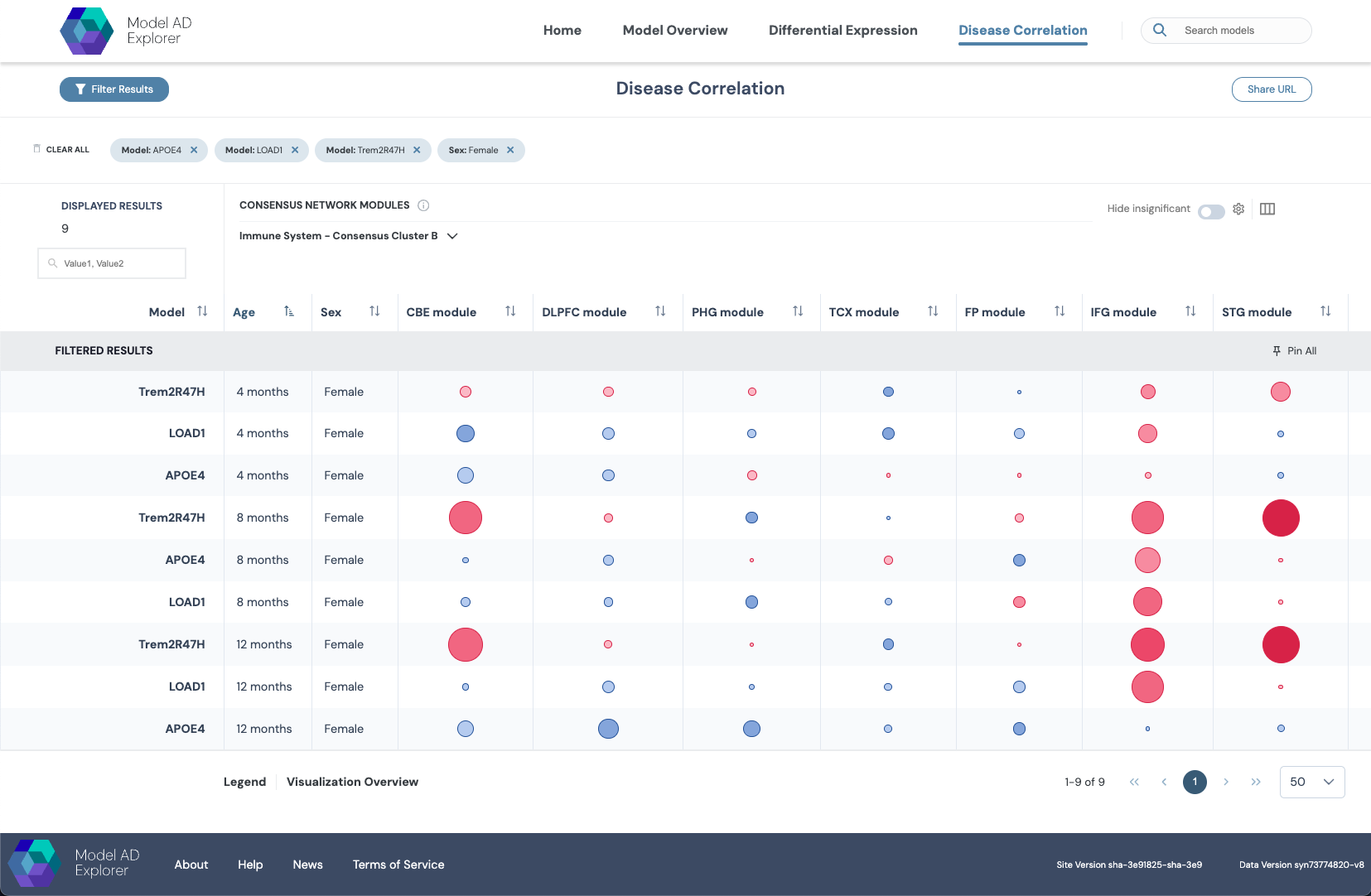
With the Model AD Explorer, users can visualize detailed phenotypic characterizations of mouse models, including biomarkers, pathology, and RNA differential expression data. Notably, disease correlation data informs researchers of how closely changes in mouse gene expression parallel the disease in humans. This makes it easier for researchers to identify a mouse model aligned with their research goals.
The platform supports side-by-side comparisons and downloadable visualizations, allowing researchers to explore gene expression and neuropathology data in more depth. The tool emphasizes transparency, with clear data provenance, access to raw datasets, and statistical context to help users assess the significance of differences across models.
At its core, the ModelAD Explorer reflects a broader shift in Alzheimer’s research toward more reproducible science and greater therapeutic relevance. As datasets grow larger and more complex, tools like this can help researchers spend less time sorting through data and more time asking meaningful questions.
“Using the tool to select a mouse model that’s appropriate for your research will allow the research community to do better science and see faster progress,” Dr. Britton said, “because [they] won’t be characterizing artificial biology that’s not aligned with the actual disease in humans.”
Researchers are invited to view the new Model AD Explorer and provide feedback as the platform continues to evolve.